Performances / Nagyvárad Dance Ensemble / 2026-2027
Madách Imre
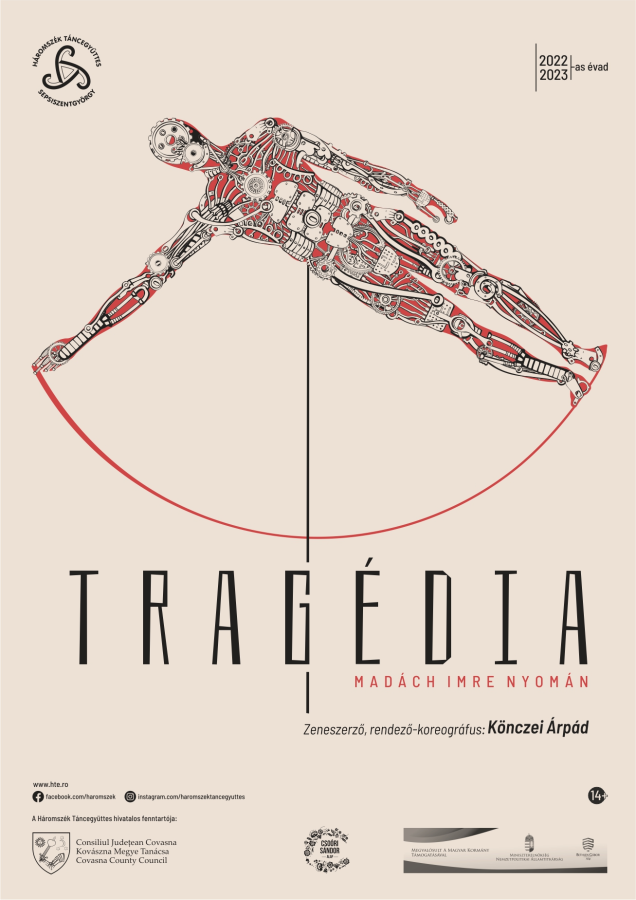
TRAGEDY - Háromszék Dance Ensemble
Based on Imre Madách’s play The Tragedy of The Man
Why?
Why did I think that we can create a choreography, a dance performance based on Madách's Tragedy? Is it possible to express the complexity and philosophical drama of the text through the combination of music-dance-movement-scenery-film or with a shortened version of the text, or are we dooming the play to failure like Lucifer's cold logic, denial and harsh criticism which seeks flaw in everything?
British author, poet and philosopher Aldous Huxley wrote his best-known novel, the dystopia Brave New World in 1931. The novel is set in an imaginary faraway future: a perfectly organized society, a scientific caste system, free will eradicated by methodical education, free sexuality in exchange for a family and slavery made bearable by a perfect drug called ’Soma’. In 1958 – twenty six years after the publication of the novel in 1932 - Huxley wrote the following in a series of essays entitled Return to the Brave New World: „My predictions from 1931 are fulfilling much sooner than I expected”. Huxley is long gone, he died in 1963, but what would he think about our present?
Huxley's study guided me to the work of Imre Madách. Madách had a similar vision of the future 100 years before Huxley, around 1859-60. In Madách's time London was the most advanced society in Europe and in the world, an enormous industrial and economic power. But Madách did not end his best-known play with the London scene, his own present, but instead he returned to think about the future of Adam and Eve. The phalanstery, the space, the Eskimo scenes are all pessimistic predictions, dystopias of the fall and destruction of mankind. I believe that Madách's texts – which appear also in this dance-theatre-drama - are still valid and relevant today. „Man has become stronger than God" (Pharaoh). „Now all the earth is a broad homeland" (Lucifer). To which Adam's earthbound response is: „I have but one regret, the notion of home, It might have lasted, I think, in this new order." Yes, now the new order is being formed, the brave new world, in which grand promises are being made again and the great slogans, "Equality, brotherhood, liberty!" are being emptied out. Through this brainwashing predicted by Huxley, through these slogans and false promises the masses can be manipulated once again into a new phalanstery.
The Tragedy performance based on Madách's work is intended to be thought-provoking first of all. Through the art of dance (folk dance, contemporary dance, movement) I ask questions about the relationship between man and woman, between the individual and the masses, about faith, love, freedom, competition and the existence of the phalanstery, and I try to provide some answers as well. Without the past there is no future, says the poet Babits Mihály, and looking at the present I would say, without the future we have no future. „I told you, man: fight, trust and be full of hope!”
CAST:
The Lord - Fazakas Tamás
Angels' Choir - Iffiú Boróka, Kocsis Tekla, Kocsis Ünige, Kolcsár Zonga, Szilágyi Katalin, Vetró Bodoni Flóra
Adam - Márton Csaba
Eve - Márton Edina-Emőke
Lucifer - Melles Endre
The Earth's Spirit - Erőss Judit
Catulus - Kiss Adorján
Hippia - Ádám Júlia, Both Eszter
Cluvia - Podholiczky Rebeka Ráhel, Vass Tünde
Gladiators - Portik Norbert, Szvinyuk Sándor
Peter Apostle - Fazakas Levente
Helene - Lukács Réka
Robespierre - Portik Norbert
Saint-Just - Kiss Adorján
The Marquis - Fülöp Zoltán-József
Mother of Eve - Lukács Réka
Scientist/phalanstery - Kocsis Lilla-Tünde
Two eskimos - Pável Hunor-Mihály, Szvinyuk Sándor
Slaves, choir, heretics, friends, revolutioners, citizens, workers, students, phalanstery people: Ádám Júlia, Both Eszter, Fazakas Mónika, Gere Gabriella, Kocsis Lilla-Tünde, Lukács Réka, Podholiczky Rebeka Ráhel, Vass Tünde, Vitályos Dorottya, Balla Gergely, Fülöp Zoltán-József, Gere Csaba, Kiss Adorján, Pável Hunor-Mihály, Portik Norbert, Szvinyuk Sándor
Heveder Band: Fazakas Levente, Fazakas Albert, Szilágyi László, Bajna György
Contributors to the sound recordings: Árendás Péter, Bajna György, Fazakas Albert, Fazakas Levente, Kertész János, ifj. Koszorús Kálmán, Könczei Árpád, Liber Róbert, Papp István Gázsa, Péter János, Réman Zoltán, Szilágyi László
Post-production: Kertész Huba
CREATORS:
Dramaturg: Kozma András
Assistant choreographer: Melles Endre
Assistant choreographer, ballet master: Cseke Ágnes
Costumes assistant: Csüdöm Eszter
Props master: Zayzon Ádám
Cameraman: László Barna
Artistic collaborator, choreographer: ifj. Zsuráfszky Zoltán, Harangozó-prize
Decor and costumes: Balázs Gyöngyi
Music composer, director-choreographer: Könczei Árpád, Harangozó-prize
The performance is not recommended for children under 14 years!
The Háromszék Dance Company is officially sustained by the Covasna County Council.
The production was financed by the Bethlen Gábor Fund and the Csoóri Sándor Fund.